
When my editor suggested that, in honor of America’s 250th birthday this summer, we run a series highlighting several local veterans over time, I was excited to get started. As a military wife, I am so proud of the work our veterans do day in and day out. Here in the Sewickley area, we are so fortunate that our community has called awareness to many of the brave by hanging banners in the community to showcase some of these exemplary individuals. Our Sewickley Veteran banner program is something to be proud of, and I encourage you to take a minute to reflect on these banners when you are running errands in town.
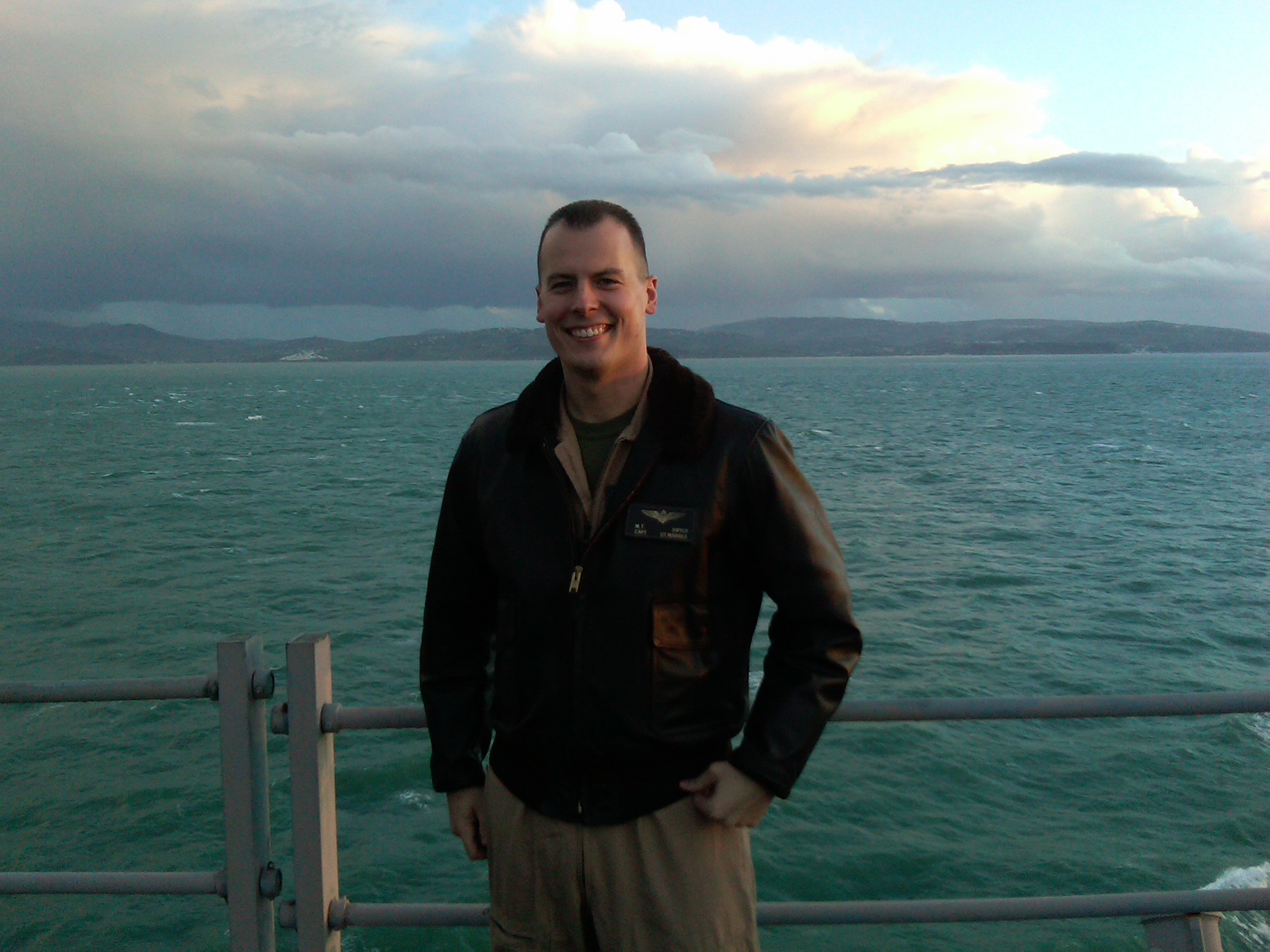
There are simply too many exceptional examples of courage, bravery and selflessness within our community. If our magazine held the space, I would be glad to try my hand at sharing their stories, one by one, but I am only given the opportunity to highlight a few throughout the year. This month, I would like to take the opportunity to share the story of my husband, Matthew, and his experience as a VMM-162 Osprey pilot, on the occasion of his 20th anniversary of his winging at Naval Air Station (NAS) Whiting Field in Milton, Florida.
Matt’s story is not necessarily unique in its initial start. As a young, headstrong teenager, Matt wished to enlist immediately, so early, in fact, that he needed parental permission to complete the paperwork just shy of his 18th birthday. His parents, while proud of his desire to serve, weren’t keen on the fact that this was being done in such a hurried fashion, and encouraged Matt to take some time to complete his degree as a reservist before entering into the military full-time. Matt knew from a young age that he wanted to be a pilot, and greatly feared that a million and one things might do anything possible to thwart that plan. Like so many others, he was enthralled with the speed and excitement jet pilots convey in movies such as Top Gun, and thought this was the path for him. The USMC thought otherwise, and offered him the option to be a MV-22 Osprey pilot.
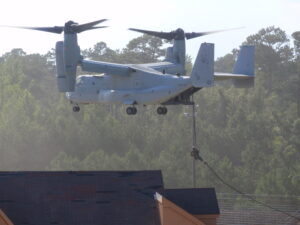
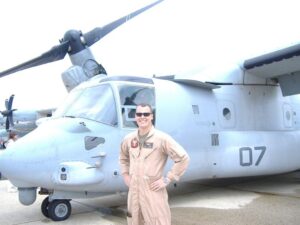
When someone mentions the MV-22 Osprey, the conversation usually goes in one of two directions. The first is usually like this: “Oh! That’s the plane that crashes all the time, right? I thought those were grounded now?” or, it goes: “What? I’ve never heard of that?” Let’s start with the former of the two. Dwyer himself admits that the aircraft has had a checkered past. “Yes, the MV-22 Osprey does not, in fact, have the best reputation. It has, in fact, had 15 major accidents since the aircraft’s developmental phase,” says Dwyer. For those that are not familiar with the MV-22 Osprey, this is the plane that doesn’t exactly look like a plane at all. It’s large, with funny wings, that one will notice over time can go not only vertically, but horizontally. This is the magic of this aircraft. “It can fly as both a helicopter and an airplane, combining the versatility of a helicopter with the range and speed of an airplane.” says Dwyer. It’s incredibly unique, can fit into spaces that typical aircraft cannot, and has a mysterious, if somewhat dangerous allure about it. Something unique to its engineering feat that makes it a fantastic conversation starter, as many of our community friends well know by now!
The VMM-162 squadron is located at Marine Corps Air Station New River in North Carolina. “I was offered a unique opportunity to be one of the first Lieutenants that was selected for the V-22 program,” says Dwyer: “Standing up the squadron, typically, is a very rare event in the USMC, and I felt that was a very special opportunity. Everyone came into that squadron not knowing the airplane. All of us, from the lieutenants, to the Captains, to the Majors, had to learn the airplane together, which doesn’t normally happen. It allowed me, as a young First Lieutenant, to gain highly valuable, and sought-after, experience quickly, and I found myself with more V-22 hours than most, very quickly, which made me one of the more experienced pilots than I would have been, in another squadron.” The VMM-162 squadron, simply, did not yet exist, and the task was great: “Standing up the squadron is like starting an organization from scratch. All of the policies and procedures must be written; there is no culture to come into. The culture must be created, and formed, instantly,” says Dwyer. “The command culture was driven entirely by the commanding officer, who, at the time, was Lt. Colonel Karsten Heckl, who became the interim Commandant of the USMC in 2023 as a Lieutenant General.”
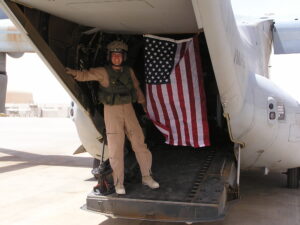
Throughout his time with VMM-162, Matt endured two deployments. The first deployment, to Al-Asad Air Base in Iraq, was a six-month deployment in support of Operation Iraqi Freedom. “It was the second operational deployment of the aircraft. We replaced the first squadron that primarily did VIP lifts and transportation, where our squadron was able to develop new tactics and procedures for the Osprey,” recalls Dwyer. Dwyer also had the privilege of flying then-Senator Barack Obama, the Democratic Presidential nominee, during this deployment: “Senator Obama had been skeptical of the V-22 prior to his flight, and saw the value of the aircraft firsthand on a flight from Ar Ramadi to Amman, Jordan, a flight only capable of being flown by the Osprey.”
Fifteen months later, Dwyer faced a second deployment that presented a unique opportunity: “We were deployed several weeks early to respond to the earthquake that caused devastation in Haiti, in January of 2010. We flew water, food and medical supplies to remote villages throughout the country and, of my most notable missions, was to med-evac an 11-year-old girl with a compound leg fracture which was life-threatening, due to the inaccessibility of medical treatment. From there, the squadron left, from Haiti, aboard the USS Nassau, to conduct operations around the Horn of Africa.”
“After my second deployment, I helped the squadron prepare for their third deployment, but then was assigned as the Standardization Instructor pilot for the training squadron, where I was tasked with rewriting our policies, namely procedures that teach new pilots how to fly the Osprey. Here, I was able to put my experience over the last two deployments into the curriculum, so that my experience could have a lasting effect on the program-that is what I am most proud of,” says Dwyer, “…so that others can learn from the experience, and fly the airplane as safely as possible.” Dwyer went on to serve for two more years of active duty before honorably discharging from the USMC to transition into a career into the commercial airlines. Dwyer’s legacy as a V-22 Osprey pilot continues to help others. In 2013, he was inducted into the Smithsonian Air and Space Museum, a pivotal moment for Dwyer: “I grew up (outside of the DC area), going to school field trips here every year. It felt like a full-circle moment, to be able to give back a little piece of history and experience, to a museum to share and inspire the next round of pilots and future aviators.”
July 29, 2006 marks the date Dwyer received his gold wings at NAS Whiting Field. Reflecting on this and the upcoming 250th celebration of the birth of our country, Dwyer recalls, “I have a mug from my winging, and every naval aviator is assigned a chronological number. My number is around 28,000. It shows you the incredibly small group of people who have been given the opportunity to wear the wings of gold, and have such an impact on US history. With the 250th anniversary of our country approaching, it is good to reflect back on the men and women who have served this great country, to allow us the freedoms that we all hold dearly, and a gentle reminder to those that, if we want to continue our way of life, we still need brave men and women to do the job, to stand on the wall, to fight the good fight.”